01
Ten years in
On October 17 we marked ten years of CC Fest. People joined from Sarajevo, Glasgow, Athens, Brighton, Minneapolis, the East Bay, Oregon, and elsewhere. Some were here for the first time; others had returned again and again. By my count, this was our thirtieth event. Since there is some confusion about the exact number I suggested in the chat that CC Fest is zero-indexed.
The idea for CC Fest has stayed the same: a place to support creativity and learning, open and inclusive, where we learn together. Dan Shiffman hosted the first CC Fest at ITP, and Lauren Lee McCarthy’s work on p5.js helped shape how many of us think about tools and community. Having them open and close the anniversary meant a lot to me. This year we added our first panel and joined the month’s Processing Community Day celebrations.
02
Why keep making?
Dan opened with a question: if AI can write the code, why learn to write it? Drawing on Mitch Resnick, he described coding as a way to think and find a voice. Mistakes, exploration, and slowness were things he would not want to lose.
“The tedious stuff is the creative part.”
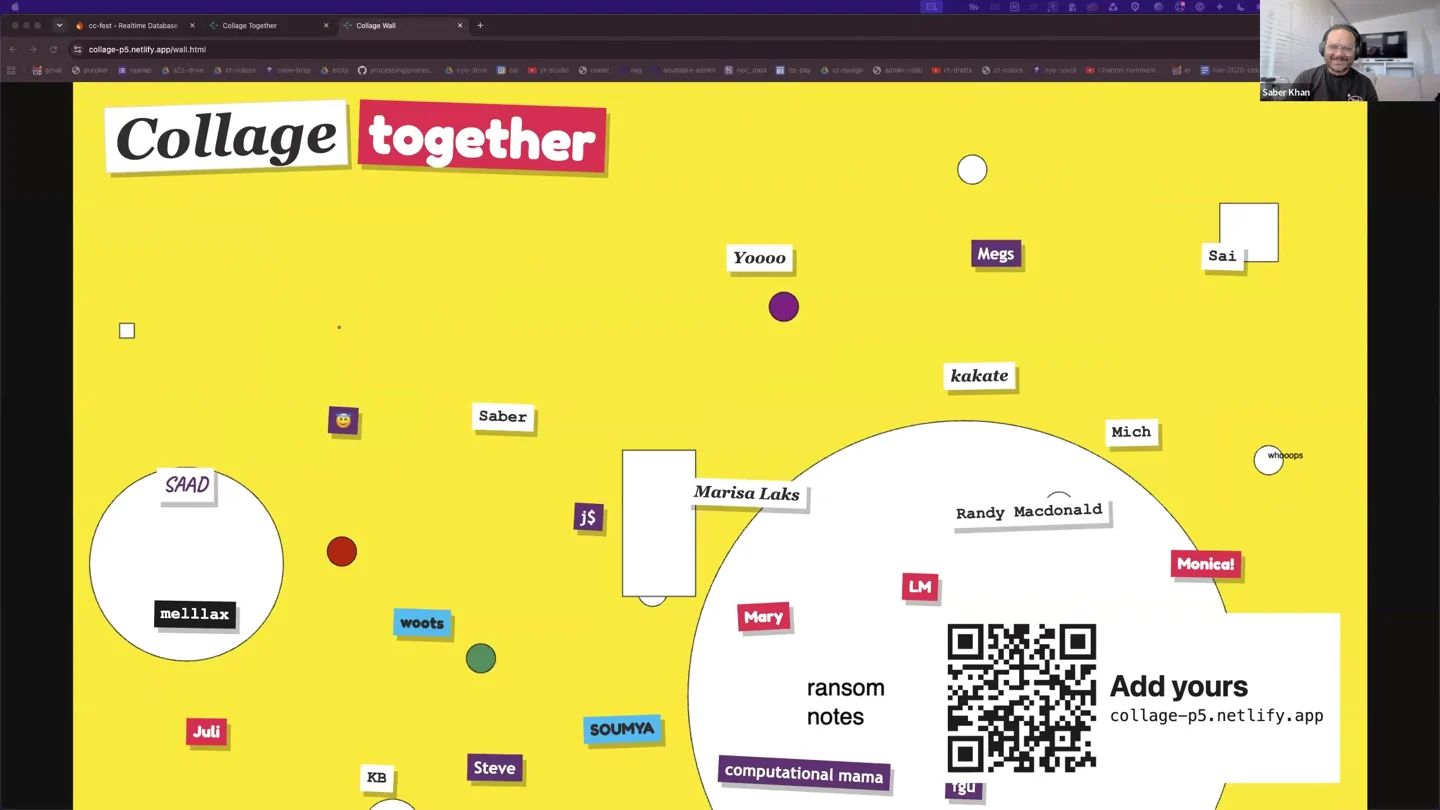
He used Allison Parrish’s collage metaphor to ask what disappears when a work’s sources and processes are hidden. In the community he described, sketches and remixes circulate with their seams showing. He ended by inviting everyone to add to a shared p5.js canvas. The gathering itself became a collage.
03
How do we make tools our own?
Naoto Hieda explicitly picked up Dan’s argument for taking time. In the Neocities workshop, that became a rhythm: edit one thing, save, reload, and look at what changed. Tristan Bunn offered another way into familiar ideas through his Python port of The Nature of Code. Presenting from Australia at 3:35 in the morning, he stayed after the talk to help a teacher get py5 running in VS Code.
Caleb Foss approached the question through declarative code: describe the result you want instead of spelling out every step. Kemi Ukadike’s playground asked makers to state an intention and a description before adding an object, preserving those decisions in a portable schema card. These were different ways to make a tool easier to understand, question, and shape. They also left room for different positions on AI: Kemi described practical access benefits from assistance, while Caleb explored alternatives to relying on large language models.
04
What can a few rules produce?
Julien Gachadoat reconstructed John Roy’s Segrid from its image and published process notes, then varied the rules to make new patterns. Sai Ram Ved Vijapurapu built a black-and-white ripple by giving similar shapes slightly different timing. In both workshops, a small change in a rule produced a visible change in the work.
Matthew Raupp’s Collage Machine brought chance into composition: a tool offered fragments, and a person decided how to arrange them. It echoed Dan’s shared collage without using the same software. Kofi Oduro began further from the screen, asking people to combine a color and a meal, then imagine how the dish would move, sound, and smell. As his webcam became a grid of green-and-purple faces in Hydra, those private associations became starting points for play.
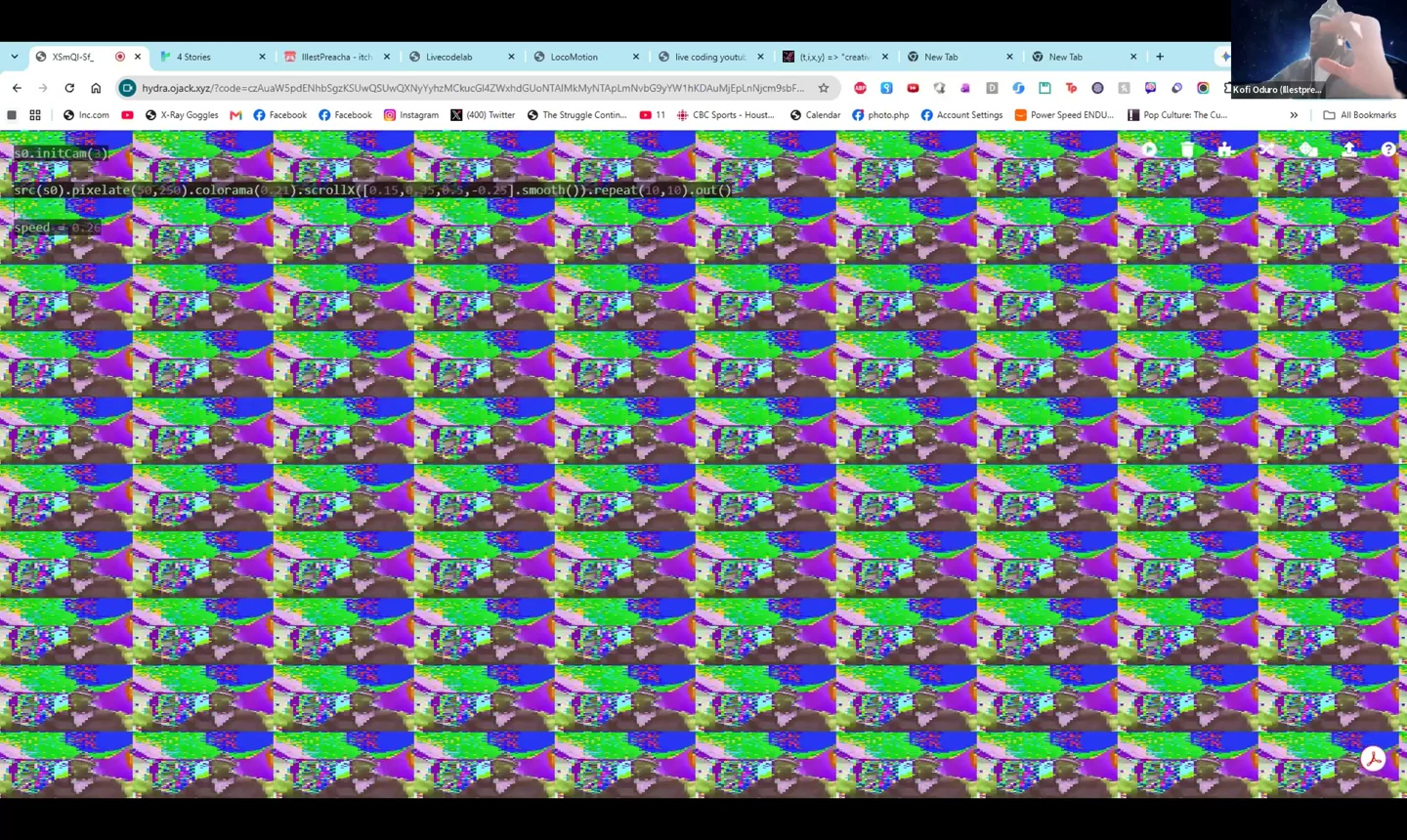
Kofi Oduro’s webcam, pixelated and tiled in Hydra.
05
What happens when code meets a material?
Blair Subbaraman showed the same basket-weave design printed with different machines and materials. Sandra Soto raised her hand beside a servo-driven creature, connecting Teachable Machine, a micro:bit, and a motor. Aleksandra Jovanić worked out how a curve could leave one face of a printable cube net and arrive at the correct edge of another. Shane Curry held an LED grid beside the software that animated it. A material, a gesture, a fold, and a pattern of light each made a different part of the process visible.
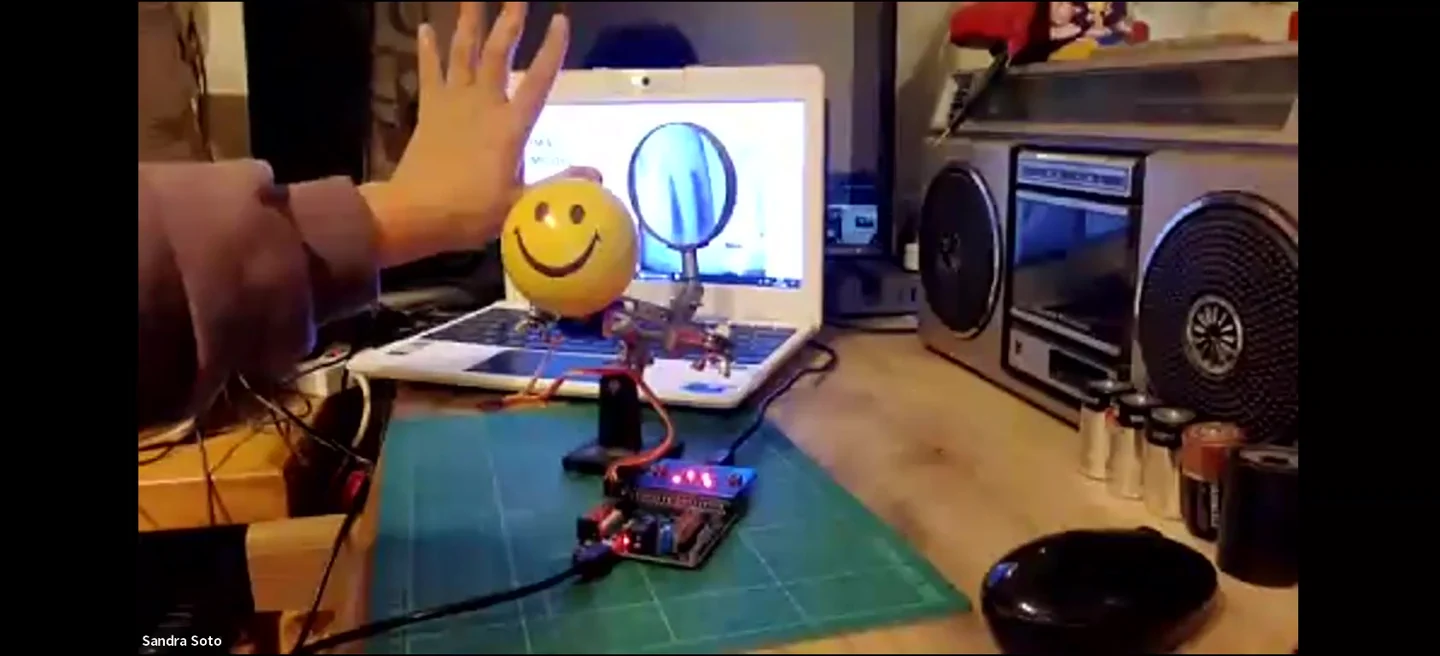
Sandra Soto’s hand beside the servo creature.
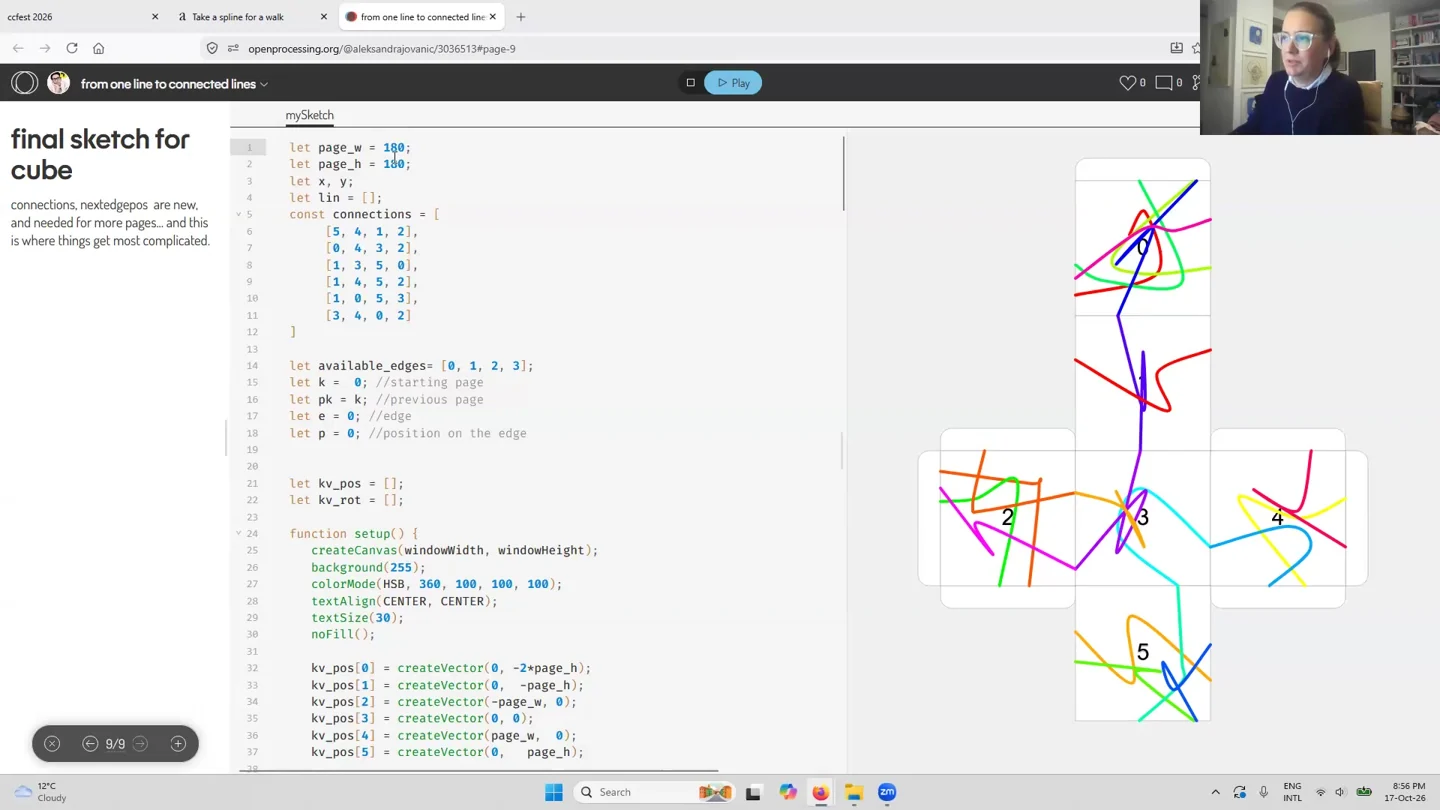
Aleksandra Jovanić’s curves cross the faces of a printable cube net.
Missy Cooper brought that question back to a viewer’s experience. After asking participants to find an object that “remembers a hand,” she described a painting whose conductive border triggers a line of text. Should the line stay, fade, or vanish when a finger lifts? That was a storytelling decision. She asked people to connect an action, a response, and a reason in one sentence.
“The hard part is usually the because.”
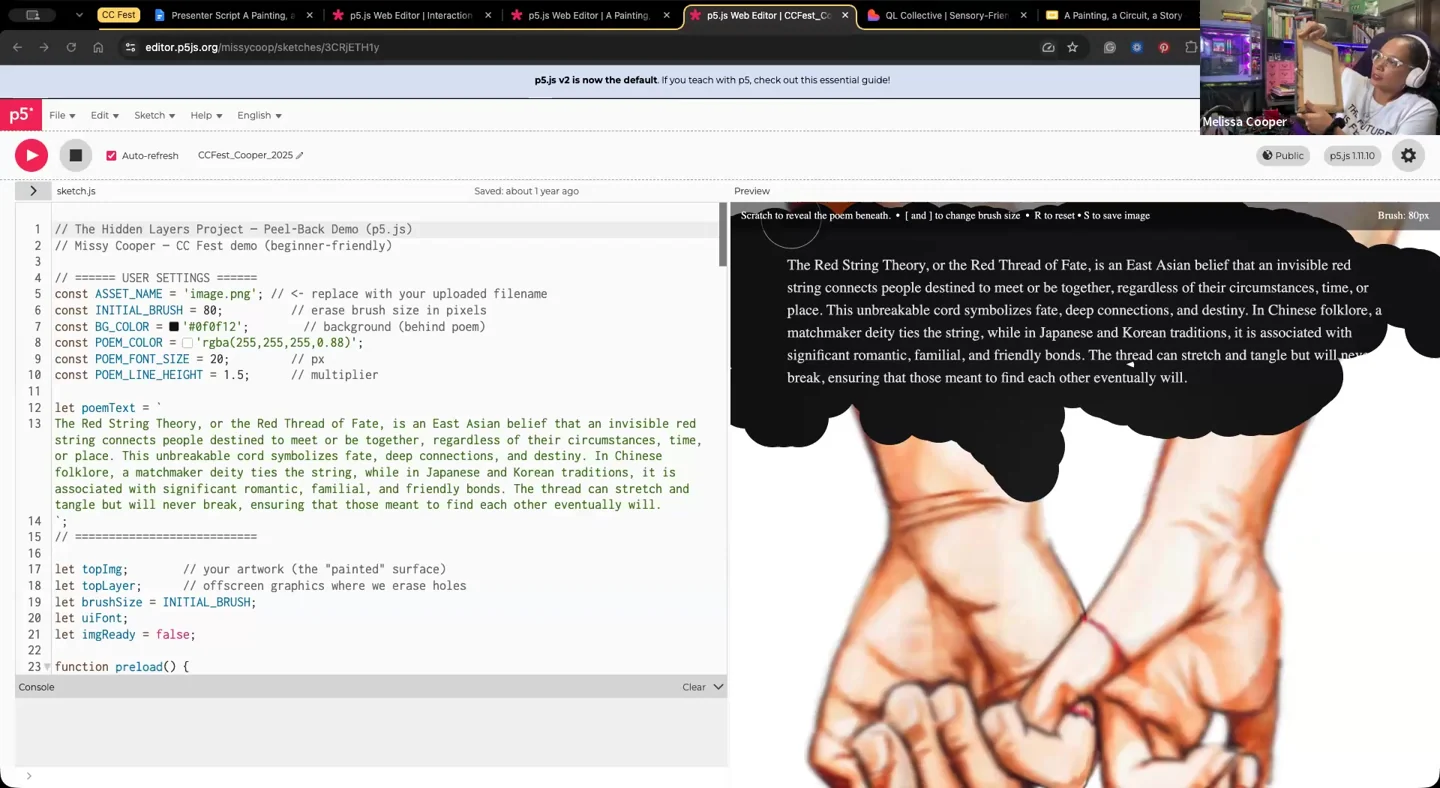
Missy’s earlier screen-based scratch-away piece. This year’s workshop took the idea into a physical painting.
Shane’s use of coding agents alongside his opposition to visual generative AI, and Missy’s discussion of AI as a useful rubber duck, kept the conversation open. The sessions did not arrive at one position on these tools.
06
How do we learn by looking together?
Emily Thomforde made a bouncing ball’s behavior inspectable by plotting its height and velocity. Jessica Valarezo used invented basketball data to show what happens when a model trained on close shots encounters a different range of shots. Both moved beyond a plausible-looking result to ask what was happening underneath.
M DeNardo let a Scratch demo fail and kept teaching. When two scripts shared the same arrow key, other eyes helped find the problem. On our first teaching panel, David DeLiema described the humor and care that can enter those debugging conversations.
“There’s humor, there’s joy, there’s empathy. It’s human interaction. It’s human connection.”
Amy B. Woodman connected questions about taste and judgment to the balance of order and chaos in Aleksandra’s existing Take a Spline for a Walk tutorial. Daniel Schneider argued that policy discussions too often leave out students’ desire to create, while describing how AI helped his father build a website. Adrienne Gifford reported that almost none of her seventh graders chose an optional AI agent for an identity-based pixel art project. She suggested a future panel with students, and I would love to make that happen.
I closed the panel by asking educators to use the agency they have in their classrooms: make room for skeptical voices, let people see how tools work, and build a community where students can help shape the process.
07
Who gets to take part?
Lauren returned to the origins of p5.js, where community statements, accessibility, and rotating leadership were part of building the tool. Opening Captions, made with Alison O’Daniel through Social Software, treated the placement and appearance of captions as expressive choices. In the Q&A, she pointed to disability-community work such as Alt Text as Poetry and asked what we assume about the person receiving what we make.
Speaking about participation in the p5.js community, she offered an invitation worth carrying into CC Fest’s next ten years:
“You don’t need to be an expert. You don’t need to prove yourself before you get here.”
08
Thank you
Thank you to Dan and Lauren; to Amy, Daniel, David, and Adrienne for trying something new with us; to every workshop presenter; and to everyone who joined. Francisca José Rodrigues co-hosted and designed the refreshed website. Shristi Singh, who has helped with CC Fest’s design for years, built its new front-page interactives. Francisca also volunteering during the event and helped keep us on schedule. Thank you to them and to the volunteers who keep this gathering going.
Every session has a recap and replay below. If you teach AP CS A, join us for Visible Java: Processing for AP CS A, a free online camp in November and December, with dates set from the interest list. We will be back in the spring.